Greedy Introduction

Greedy algorithms are simple and straightforward. They are shortsighted in their approach in the sense that they take decisions on the basis of information at hand without worrying about the effect these decisions may have in the future. They are easy to invent, easy to implement and most of the time quite efficient. Many problems cannot be solved correctly by greedy approach. Greedy algorithms are used to solve optimization problems
Greedy Approach
Greedy Algorithm works by making the decision that seems most promising at any moment; it never reconsiders this decision, whatever situation may arise later.
As an example consider the problem of "Making Change".
Coins available are:
- dollars (100 cents)
- quarters (25 cents)
- dimes (10 cents)
- nickels (5 cents)
- pennies (1 cent)
Problem Make a change of a given amount using the smallest possible number of coins.
Informal Algorithm
- Start with nothing.
- at every stage without passing the given amount.
- add the largest to the coins already chosen.
Formal Algorithm
Make change for n units using the least possible number of coins.
MAKE-CHANGE (n)
C ← {100, 25,
10, 5, 1} // constant.
Sol ←
{};
// set that
will hold the solution set.
Sum ← 0 sum of
item in solution set
WHILE sum not = n
x =
largest item in set C such that sum + x ≤ n
IF
no such item THEN
RETURN "No Solution"
S ← S {value of
x}
sum ← sum + x
RETURN S
Example Make a change for 2.89 (289 cents) here n = 2.89 and the solution contains 2 dollars, 3 quarters, 1 dime and 4 pennies. The algorithm is greedy because at every stage it chooses the largest coin without worrying about the consequences. Moreover, it never changes its mind in the sense that once a coin has been included in the solution set, it remains there.
Characteristics and Features of Problems solved by Greedy Algorithms
To construct the solution in an optimal way. Algorithm maintains
two sets. One contains chosen items and the other contains rejected
items.
The greedy algorithm consists of four (4) function.
- A function that checks whether chosen set of items provide a solution.
- A function that checks the feasibility of a set.
- The selection function tells which of the candidates is the most promising.
- An objective function, which does not appear explicitly, gives the value of a solution.
Structure Greedy Algorithm
- Initially the set of chosen items is empty i.e., solution set.
- At each step
- item will be added in a solution set by using selection function.
- IF the set would no longer be feasible
- reject items under consideration (and is never consider again).
- ELSE IF set is still feasible THEN
- add the current item.
Definitions of feasibility
A feasible set (of candidates) is promising if it can be extended to produce not merely a solution, but an optimal solution to the problem. In particular, the empty set is always promising why? (because an optimal solution always exists)
Unlike Dynamic Programming, which solves the
subproblems bottom-up, a greedy strategy usually progresses in a
top-down fashion, making one greedy choice after another, reducing each
problem to a smaller one.
Greedy-Choice Property
The "greedy-choice property" and "optimal substructure" are two ingredients in the problem that lend to a greedy strategy.
Greedy-Choice Property
It says that a globally optimal solution can be arrived at by making a locally optimal choice.
Knapsack Problem
Statement A thief robbing a store and can carry a maximal weight of w into their knapsack. There are n items and ith item weigh wi and is worth vi dollars. What items should thief take?
There are two versions of problem
- Fractional knapsack problem
The setup is same, but the thief can take fractions of items, meaning that the items can be broken into smaller pieces so that thief may decide to carry only a fraction of xi of item i, where 0 ≤ xi ≤ 1.Exhibit greedy choice property.
Exhibit optimal substructure property.
- Greedy algorithm exists.
- ?????
- 0-1 knapsack problem
The setup is the same, but the items may not be broken into smaller pieces, so thief may decide either to take an item or to leave it (binary choice), but may not take a fraction of an item.Exhibit No greedy choice property.
Exhibit optimal substructure property.
- No greedy algorithm exists.
- Only dynamic programming algorithm exists.
Dynamic-Programming Solution
to the 0-1 Knapsack Problem
Let i be the highest-numbered item in an optimal solution S for W pounds. Then S`= S - {i} is an optimal solution for W-wi pounds and the value to the solution S is Vi plus the value of the subproblem.
We can express this fact in the following formula: define c[i, w] to be the solution for items 1,2, . . . , i and maximum weight w. Then
0 if i = 0 or w = 0 c[i,w] = c[i-1, w] if wi ≥ 0 max [vi + c[i-1, w-wi], c[i-1, w]} if i>0 and w ≥ wi
This says that the value of the solution to i items either include ith item, in which case it is vi plus a subproblem solution for (i-1) items and the weight excluding wi, or does not include ith item, in which case it is a subproblem's solution for (i-1) items and the same weight. That is, if the thief picks item i, thief takes vi value, and thief can choose from items w-wi, and get c[i-1, w-wi] additional value. On other hand, if thief decides not to take item i, thief can choose from item 1,2, . . . , i-1 upto the weight limit w, and get c[i-1, w] value. The better of these two choices should be made.
Although the 0-1 knapsack problem, the above formula for c is similar to LCS formula: boundary values are 0, and other values are computed from the input and "earlier" values of c. So the 0-1 knapsack algorithm is like the LCS-length algorithm given in CLR-book for finding a longest common subsequence of two sequences.
The algorithm takes as input the maximum weight W, the number of items n, and the two sequences v = <v1, v2, . . . , vn> and w = <w1, w2, . . . , wn>. It stores the c[i, j] values in the table, that is, a two dimensional array, c[0 . . n, 0 . . w] whose entries are computed in a row-major order. That is, the first row of c is filled in from left to right, then the second row, and so on. At the end of the computation, c[n, w] contains the maximum value that can be picked into the knapsack.
Dynamic-0-1-knapsack (v, w, n, W)
for w = 0 to W
do c[0, w] = 0
for i = 1 to n
do c[i, 0] = 0
for w = 1 to W
do if wi ≤ w
then if vi + c[i-1, w-wi]
then c[i, w] = vi + c[i-1, w-wi]
else c[i, w] = c[i-1, w]
else
c[i, w] = c[i-1, w]
The set of items to take can be deduced from the table, starting at c[n. w] and tracing backwards where the optimal values came from. If c[i, w] = c[i-1, w] item i is not part of the solution, and we are continue tracing with c[i-1, w]. Otherwise item i is part of the solution, and we continue tracing with c[i-1, w-W].
Analysis
This dynamic-0-1-kanpsack algorithm takes θ(nw) times, broken up as follows:
θ(nw) times to fill the c-table, which has (n+1).(w+1) entries, each requiring θ(1) time to compute. O(n) time to trace the solution, because the tracing process starts in row n of the table and moves up 1 row at each step.
Greedy Solution to the
Fractional Knapsack Problem
There are n items in a store. For i =1,2, . . . , n, item i has weight wi > 0 and worth vi > 0. Thief can carry a maximum weight of W pounds in a knapsack. In this version of a problem the items can be broken into smaller piece, so the thief may decide to carry only a fraction xi of object i, where 0 ≤ xi ≤ 1. Item i contributes xiwi to the total weight in the knapsack, and xivi to the value of the load.
In Symbol, the fraction knapsack problem can be stated as follows.
maximize nSi=1 xivi
subject to constraint nSi=1
xiwi
≤ W
It is clear that an optimal solution must fill the knapsack exactly, for otherwise we could add a fraction of one of the remaining objects and increase the value of the load. Thus in an optimal solution nSi=1 xiwi = W.
Greedy-fractional-knapsack (w, v, W)
FOR i =1 to n
do x[i] =0
weight = 0
while weight < W
do i = best remaining item
IF weight + w[i] ≤ W
then x[i] = 1
weight = weight + w[i]
else
x[i] = (w - weight) / w[i]
weight = W
return x
Analysis
If the items are already sorted into decreasing order of
vi / wi,
then
the while-loop takes a time in
O(n);
Therefore, the total time including the sort is in O(n log n).
If we keep the items in heap with largest
vi/wi
at
the root. Then
- creating the heap takes O(n) time
- while-loop now takes O(log n) time (since heap property must be restored after the removal of
root)
Although this data structure does not alter the worst-case, it may be faster if only a small number of items are need to fill the knapsack.
One variant of the 0-1 knapsack problem is when order of items are sorted by increasing weight is the same as their order when sorted by decreasing value.
The optimal solution to this problem is to sort by the value of the item in decreasing order. Then pick up the most valuable item which also has a least weight. First, if its weight is less than the total weight that can be carried. Then deduct the total weight that can be carried by the weight of the item just pick. The second item to pick is the most valuable item among those remaining. Keep follow the same strategy until thief cannot carry more item (due to weight).
Proof
One way to proof the correctness of the above algorithm is to
prove the greedy choice property and optimal substructure property. It consist
of two steps. First, prove that there exists an optimal solution begins with the
greedy choice given above. The second part prove that if
A is an optimal
solution to the original problem S, then
A - a is also an optimal
solution to the problem S - s where
a is the item thief picked as in
the greedy choice and S - s is the subproblem after the first greedy choice
has been made. The second part is easy to prove since the more valuable items
have less weight.
Note that if v` / w`
, is not it can replace any other because
w` < w, but it increases the value because
v` > v.
□
Theorem The fractional knapsack problem has the greedy-choice property.
Proof Let the ratio v`/w` is maximal. This supposition implies that v`/w` ≥ v/w for any pair (v, w), so v`v / w > v for any (v, w). Now Suppose a solution does not contain the full w` weight of the best ratio. Then by replacing an amount of any other w with more w` will improve the value.An Activity Selection Problem
An
activity-selection is the problem of scheduling a resource among several
competing activity.
Problem Statement
Given a set S of n activities with and start time, Si and fi, finish time of an ith activity. Find the maximum size set of mutually compatible activities.
Compatible Activities
Activities i and j are compatible if the half-open internal [si, fi) and [sj, fj)
do not overlap, that is, i and j are compatible if si ≥ fj and sj ≥ fi
Greedy Algorithm for Selection Problem
I. Sort the input activities by increasing finishing time.
f1 ≤ f2 ≤ . . . ≤ fnII. Call GREEDY-ACTIVITY-SELECTOR (s, f)
- n = length [s]
- A={i}
- j = 1
- for i = 2 to n
- do if si ≥ fj
- then A= AU{i}
- j = i
- return set A
Operation of the algorithm
Let 11 activities are given S = {p, q, r, s, t, u, v, w, x, y, z} start and finished times for proposed activities are (1, 4), (3, 5), (0, 6), 5, 7), (3, 8), 5, 9), (6, 10), (8, 11), (8, 12), (2, 13) and (12, 14).
A = {p} Initialization at line 2
A = {p, s} line 6 - 1st iteration of FOR - loop
A = {p, s, w} line 6 -2nd iteration of FOR - loop
A = {p, s, w, z} line 6 - 3rd iteration of FOR-loop
Out of the FOR-loop and Return A = {p, s, w, z}
Analysis
Part I requires O(n lg n) time (use merge of heap sort).
Part II requires θ(n) time assuming that activities were already sorted in part I by their finish time.
Correctness
Note that Greedy algorithm do not always produce optimal solutions but GREEDY-ACTIVITY-SELECTOR does.
Theorem Algorithm GREED-ACTIVITY-SELECTOR produces solution of maximum size for the activity-selection problem.
Proof Idea Show the activity problem satisfied
- Greedy choice property.
- Optimal substructure property.
Proof
- Let S = {1, 2, . . . , n} be the set of activities. Since
activities are in order by finish time. It implies that activity 1 has the
earliest finish time.
Suppose, A S is an optimal solution and let activities in
A are ordered by finish time. Suppose, the first activity in
A is
k.
S is an optimal solution and let activities in
A are ordered by finish time. Suppose, the first activity in
A is
k.
If k = 1, then A begins with greedy choice and we are done (or to be very precise, there is nothing to proof here).
If k 1, we want to show that there is another solution
B that
begins with greedy choice, activity 1.
1, we want to show that there is another solution
B that
begins with greedy choice, activity 1.
Let B = A - {k} {1}. Because
f1
{1}. Because
f1
 fk,
the activities in B are disjoint and since
B has same number of
activities as A, i.e., |A| = |B|,
B is also optimal.
fk,
the activities in B are disjoint and since
B has same number of
activities as A, i.e., |A| = |B|,
B is also optimal. - Once the greedy choice is made, the problem reduces to finding an
optimal solution for the problem. If
A is an optimal solution to the
original problem
S, then
A` = A - {1} is an optimal solution to
the activity-selection problem
S` = {i
 S: Si
S: Si
 fi}.
fi}.
why? Because if we could find a solution B` to S` with more activities then A`, adding 1 to B` would yield a solution B to S with more activities than A, there by contradicting the optimality. □
As an example consider the example. Given a set of activities to among lecture halls. Schedule
all the activities using minimal lecture halls.
In order to determine which activity should use which lecture hall, the
algorithm uses the GREEDY-ACTIVITY-SELECTOR to calculate the activities in the
first lecture hall. If there are some activities yet to be scheduled, a new
lecture hall is selected and GREEDY-ACTIVITY-SELECTOR is called again. This
continues until all activities have been scheduled.
LECTURE-HALL-ASSIGNMENT (s, f)
n = length [s)
for i = 1 to n
do HALL [i] = NIL
k = 1
while (Not empty (s))
do HALL [k] = GREEDY-ACTIVITY-SELECTOR (s, t, n)
k = k + 1
return HALL
Following changes can be made in the GREEDY-ACTIVITY-SELECTOR (s, f) (see CLR).
j = first (s)
A = i
for i = j + 1 to n
do if s(i) not= "-"
then ifGREED-ACTIVITY-SELECTOR (s, f, n)
j = first (s)
A = i = j + 1 to n
if s(i] not = "-" then
if s[i] ≥ f[j]|
then A = AU{i}
s[i] = "-"
j = i
return A
Correctness
The algorithm can be shown to be correct and optimal. As a contradiction, assume the number of lecture halls are not optimal, that is, the algorithm allocates more hall than necessary. Therefore, there exists a set of activities B which have been wrongly allocated. An activity b belonging to B which has been allocated to hall H[i] should have optimally been allocated to H[k]. This implies that the activities for lecture hall H[k] have not been allocated optimally, as the GREED-ACTIVITY-SELECTOR produces the optimal set of activities for a particular lecture hall.
Analysis
In the worst case, the number of lecture halls require is n. GREED-ACTIVITY-SELECTOR runs in θ(n). The running time of this algorithm is O(n2).
Two important Observations
- Choosing the activity of least duration will not always produce
an optimal solution. For example, we have a set of activities {(3, 5), (6, 8),
(1, 4), (4, 7), (7, 10)}. Here, either (3, 5) or (6, 8) will be picked first,
which will be picked first, which will prevent the optimal solution of {(1, 4),
(4, 7), (7, 10)} from being found.
- Choosing the activity with the least overlap will not always produce solution. For example, we have a set of activities {(0, 4), (4, 6), (6, 10), (0, 1), (1, 5), (5, 9), (9, 10), (0, 3), (0, 2), (7, 10), (8, 10)}. Here the one with the least overlap with other activities is (4, 6), so it will be picked first. But that would prevent the optimal solution of {(0, 1), (1, 5), (5, 9), (9, 10)} from being found.
Huffman Codes
Huffman code is a technique for compressing data. Huffman's greedy algorithm look at the occurrence of each character and it as a binary string in an optimal way.
Example
Suppose we have a data consists of 100,000 characters that we want to compress. The characters in the data occur with following frequencies.
a
b
c
d
e
f
Frequency 45,000
13,000
12,000
16,000
9,000
5,000
Consider the problem of designing a "binary character code" in which each character is represented by a unique binary string.
Fixed Length Code
In fixed length code, needs 3 bits to represent six(6) characters.
|
a |
b |
c |
d |
e |
f |
|
| Frequency |
45,000 |
13,000 |
12,000 |
16,000 |
9,000 |
5,000 |
| Fixed Length code | 000 | 001 | 010 | 011 | 100 | 101 |
This method require 3000,000 bits to code the entire file.
How do we get 3000,000?
- Total number of characters are 45,000 + 13,000 + 12,000 + 16,000 + 9,000 + 5,000 = 1000,000.
- Add each character is assigned 3-bit codeword => 3 * 1000,000 = 3000,000 bits.
Conclusion
Fixed-length code requires 300,000 bits while variable code requires 224,000 bits.
=> Saving of approximately 25%.
Prefix Codes
In which no codeword is a prefix of other codeword. The reason prefix codes are desirable is that they simply encoding (compression) and decoding.
Can we do better?
A variable-length code can do better by giving frequent characters short codewords and infrequent characters long codewords.
|
a |
b |
c |
d |
e |
f |
|
| Frequency |
45,000 |
13,000 |
12,000 |
16,000 |
9,000 |
5,000 |
| Fixed Length code | 0 | 101 | 100 | 111 | 1101 | 1100 |
Character 'a' are 45,000
each character 'a' assigned 1 bit codeword.
1 * 45,000 = 45,000 bits.
Characters (b, c, d) are 13,000 + 12,000 + 16,000 = 41,000
each character assigned 3 bit codeword
3 * 41,000 = 123,000 bits
Characters (e, f) are 9,000 + 5,000 = 14,000
each character assigned 4 bit codeword.
4 * 14,000 = 56,000 bits.
Implies that the total bits are: 45,000 + 123,000 + 56,000 = 224,000 bits
Encoding: Concatenate the codewords representing each characters of the file.
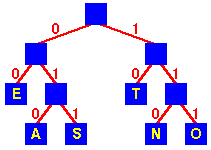
String Encoding
TEA 10 00 010
SEA 011 00 010
TEN 10 00 110
Example From variable-length codes table, we code the3-character file abc as:
a b c 0 101 100 => 0.101.100 = 0101100
Decoding
Since no codeword is a prefix of other, the codeword that
begins an encoded file is unambiguous.
To decode (Translate back to the original character), remove it from the encode
file and repeatedly parse.
For example in "variable-length codeword" table, the string 001011101 parse
uniquely as 0.0.101.1101, which is decode to aabe.
The representation of "decoding process" is binary tree, whose leaves are characters. We interpret the binary codeword for a character as path from the root to that character, where 0 means "go to the left child" and 1 means "go to the right child". Note that an optimal code for a file is always represented by a full (complete) binary tree.
Theorem A Binary tree that is not full cannot correspond to an optimal prefix code.
Proof Let T be a binary tree corresponds to prefix code such
that T is not full. Then there must exist an internal node, say x, such that x
has only one child, y. Construct another binary tree, T`, which has save leaves
as T and have same depth as T except for the leaves which are in the subtree
rooted at y in T. These leaves will have depth in T`, which implies T cannot
correspond to an optimal prefix code.
To obtain T`, simply merge x and y into a single node, z is a child of parent of
x (if a parent exists) and z is a parent to any children of y. Then T` has the
desired properties: it corresponds to a code on the same alphabet as the code
which are obtained, in the subtree rooted at y in T have depth in T` strictly
less (by one) than their depth in T.
This completes the proof.
□
|
a |
b |
c |
d |
e |
f |
|
| Frequency |
45,000 |
13,000 |
12,000 |
16,000 |
9,000 |
5,000 |
| Fixed Length code | 000 | 001 | 010 | 011 | 100 | 101 |
| Variable-length Code | 0 | 101 | 100 | 111 | 1101 | 1100 |
Fixed-length code is not optimal since binary tree is not full.
Figure
Optimal prefix code because tree is full binary
Figure
From now on consider only full binary tree
If C is the alphabet from which characters are drawn, then the tree for an optimal prefix code has exactly |c| leaves (one for each letter) and exactly |c|-1 internal orders. Given a tree T corresponding to the prefix code, compute the number of bits required to encode a file. For each character c in C, let f(c) be the frequency of c and let dT(c) denote the depth of c's leaf. Note that dT(c) is also the length of codeword. The number of bits to encode a file is
B (T) = S f(c) dT(c)
which define as the cost of the tree T.
For example, the cost of the above tree is
B (T) = S f(c) dT(c)
= 45*1 +13*3 + 12*3 + 16*3 + 9*4 +5*4
= 224
Therefore, the cost of the tree corresponding to the optimal prefix code is 224 (224*1000 = 224000).
Constructing a Huffman code
A greedy algorithm that constructs an optimal prefix code called a Huffman code. The algorithm builds the tree T corresponding to the optimal code in a bottom-up manner. It begins with a set of |c| leaves and perform |c|-1 "merging" operations to create the final tree.
Data Structure used: Priority queue = Q
Huffman (c)
n = |c|
Q = c
for i =1 to n-1
do z = Allocate-Node ()
x = left[z] = EXTRACT_MIN(Q)
y = right[z] = EXTRACT_MIN(Q)
f[z] = f[x] + f[y]
INSERT (Q, z)
return EXTRACT_MIN(Q)
Analysis
- Q implemented as a binary heap.
- line 2 can be performed by using BUILD-HEAP (P. 145; CLR) in O(n) time.
- FOR loop executed |n| - 1 times and since each heap operation requires
O(lg n) time.
=> the FOR loop contributes (|n| - 1) O(lg n)
=> O(n lg n) - Thus the total running time of Huffman on the set of n characters is O(nlg n).
Operation of the Algorithm
An optimal Huffman code for the following set of frequencies
a:1 b:1 c:2 d:3 e:5 g:13 h:2
Note that the frequencies are based on Fibonacci numbers.
Since there are letters in the alphabet, the initial queue size is n = 8, and 7 merge steps are required to build the tree. The final tree represents the optimal prefix code.
Figure
The codeword for a letter is the sequence of the edge labels on the path from the root to the letter. Thus, the optimal Huffman code is as follows:
h : 1 g : 1 0 f : 1 1 0 e : 1 1 1 0 d : 1 1 1 1 0 c : 1 1 1 1 1 0 b : 1 1 1 1 1 1 0 a : 1 1 1 1 1 1 1
As we can see the tree is one long limb with leaves n=hanging off. This is
true for Fibonacci weights in general, because the Fibonacci the recurrence is
Fi+1 + Fi + Fi-1
implies that
 i Fi = Fi+2 - 1.
To prove this, write Fj as Fj+1 - Fj-1 and sum from 0 to i, that is, F-1 = 0.
Correctness of Huffman Code Algorithm
Proof Idea
Step 1: Show that this problem satisfies the greedy choice property, that is, if a greedy choice is made by Huffman's algorithm, an optimal solution remains possible.
Step 2: Show that this problem has an optimal substructure property, that is, an optimal solution to Huffman's algorithm contains optimal solution to subproblems.
Step 3: Conclude correctness of Huffman's algorithm using step 1 and step 2.
Lemma - Greedy Choice Property Let c be an alphabet in which each character c has frequency f[c]. Let x and y be two characters in C having the lowest frequencies. Then there exists an optimal prefix code for C in which the codewords for x and y have the same length and differ only in the last bit.
Proof Idea
Take the tree T representing optimal prefix code and transform T into a tree T` representing another optimal prefix code such that the x characters x and y appear as sibling leaves of maximum depth in T`. If we can do this, then their codewords will have same length and differ only in the last bit.
Figures
Proof
Let characters b and c are sibling leaves
of maximum depth in tree T. Without loss of generality assume that
f[b] ≥ f[c]
and f[x] ≤ f[y]. Since f[x] and
f[y] are lowest leaf frequencies in order and
f[b] and f[c] are arbitrary frequencies in order. We have
f[x] ≤ f[b] and
f[y]
≤ f[c]. As shown in the above figure, exchange the positions of leaves to get
first T` and then
T``. By formula, B(t) =
c in C
f(c)dT(c), the difference
in cost between T and
T` is
B(T) - B(T`) = f[x]dT(x) + f(b)dT(b) - [f[x]dT(x) + f[b]dT`(b)
= (f[b] - f[x]) (dT(b) - dT(x))
= (non-negative)(non-negative)
≥ 0
Two Important Points
The reason f[b] - f[x] is non-negative because
x is a minimum frequency leaf
in tree T and the reason
dT(b) - dT(x) is non-negative
that b is a leaf of maximum depth in
T.
Similarly, exchanging y and c does not increase the cost which implies that
B(T)
- B(T`) ≥ 0. This fact in turn implies that
B(T) ≤ B(T`), and since
T is
optimal by supposition, which implies B(T`) = B(T).
Therefore, T`` is optimal in which
x and
y are sibling leaves of maximum depth, from which
greedy choice property follows. This complete the proof.
□
Lemma - Optimal Substructure Property Let T be a full binary tree representing an optimal prefix code over an alphabet C, where frequency f[c] is define for each character c belongs to set C. Consider any two characters x and y that appear as sibling leaves in the tree T and let z be their parent. Then, considering character z with frequency f[z] = f[x] + f[y], tree T` = T - {x, y} represents an optimal code for the alphabet C` = C - {x, y}U{z}.
Proof Idea
Figure
Proof
We show that the cost
B(T) of tree T can be expressed
in terms of the cost B(T`). By considering the component costs in equation,
B(T)
= f(c)dT(c), we show that the cost
B(T) of tree T
can be expressed in terms of the cost B(T`)
of the tree T`. For each
c belongs to C - {x,
y}, we have dT(c) = dT(c)
= f[x](dT` (z) + 1 + f[y] (dT`(z) +1)
= (f[x] + f[y]) dT`(z) + f[x] + f[y]
And B(T) = B(T`) + f(x) + f(y)
If T` is non-optimal prefix code for C`, then there exists a T`` whose leaves are the characters belongs to C` such that B(T``) < B(T`). Now, if x and y are added to T`` as a children of z, then we get a prefix code for alphabet C with cost B(T``) + f[x] + f[y] < B(T), Contradicting the optimality of T. Which implies that, tree T` must be optimal for the alphabet C. □
Theorem Procedure HUFFMAN produces an optimal prefix code.
Proof
Let S be the set of integers n ≥ 2 for which the
Huffman procedure produces a tree of representing optimal prefix code for
frequency f and alphabet C with |c| = n.
If C = {x, y}, then Huffman produces one of the following optimal trees.
figure
This clearly shows 2 is a member of S. Next assume that n belongs to S and
show that (n+1) also belong to S.
Let C is an alphabet with |c| = n + 1. By lemma 'greedy choice property', there
exists an optimal code tree T for alphabet C. Without loss of generality, if x
and y are characters with minimal frequencies then
a. x and y are at maximal depth in tree T and b. and y have a common parent
z.
Suppose that T` = T - {x,y} and C` = C - {x,y}U{z} then by lemma-optimal
substructure property (step 2), tree T` is an optimal code tree for C`. Since
|C`| = n and n belongs to S, the Huffman code procedure produces an optimal code
tree T* for C`. Now let T** be the tree obtained from T* by attaching x and y as
leaves to z.
Without loss of generality, T** is the tree constructed for C by the Huffman
procedure. Now suppose Huffman selects a and b from alphabet C in first step so
that f[a] not equal f[x] and f[b] = f[y]. Then tree C constructed by Huffman can
be altered as in proof of lemma-greedy-choice-property to give equivalent tree
with a and y siblings with maximum depth. Since T` and T* are both optimal for
C`, implies that B(T`) = B(T*) and also B(T**) = B(T) why? because
B(T**) = B(T*) - f[z]dT*(z) + [f[x] + f[y]] (dT*(z) + 1)]
= B(T*) + f[x] + f[y]
Since tree T is
optimal for alphabet C, so is
T** . And T** is the tree
constructed by the Huffman code.
And this completes the proof.
□
Theorem The total cost of a tree for a code can be computed as the sum, over all internal nodes, of the combined frequencies of the two children of the node.
Proof
Let tree be a full binary tree with n leaves. Apply induction hypothesis on the number of leaves in T. When n=2 (the case n=1 is trivially true), there are two leaves x and y (say) with the same parent z, then the cost of T is
B(T) = f(x)dT(x) + f[y]dT(y)
= f[x] + f[y] since dT(x) = dT(y) =1
= f[child1 of z] + f[child2 of z].
Thus, the statement of theorem is true. Now suppose n>2 and also suppose that
theorem is true for trees on n-1 leaves.
Let c1 and c2 are two sibling leaves in T such that they
have the same parent p. Letting T` be the tree obtained by deleting c1
and c2, we know by induction that
B(T) =
=
Using this information, calculates the cost of T.
B(T) =
=
=
=
=
Thus the statement is true. And this completes the proof.
The question is whether Huffman's algorithm can be generalize to handle ternary codewords, that is codewords using the symbols 0,1 and 2. Restate the question, whether or not some generalized version of Huffman's algorithm yields optimal ternary codes? Basically, the algorithm is similar to the binary code example given in the CLR-text book. That is, pick up three nodes (not two) which have the least frequency and form a new node with frequency equal to the summation of these three frequencies. Then repeat the procedure. However, when the number of nodes is an even number, a full ternary tree is not possible. So take care of this by inserting a null node with zero frequency.
Correctness
Proof is immediate from the greedy choice property and an optimal substructure property. In other words, the proof is similar to the correctness proof of Huffman's algorithm in the CLR.
